

Not Available
Bonds that pay you
up to15% p.a.15% p.a. Indicative fixed returns up to 15 percentFixed Returns
- SEBI RegisteredServing 1.77+ Lakh Users
- Access Exchange-Listed Bonds
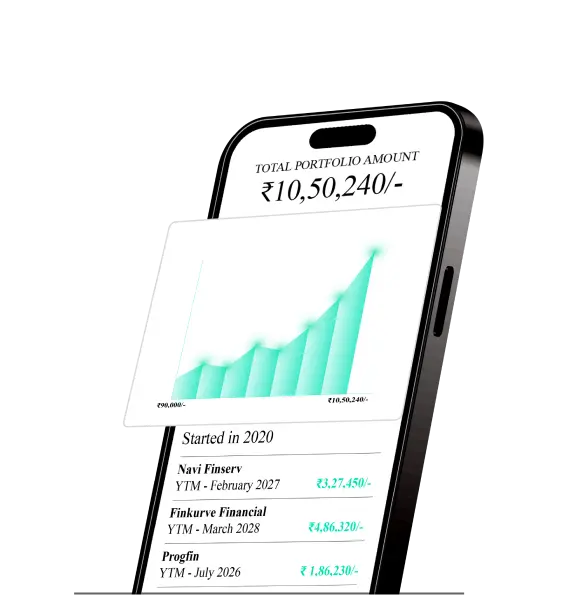
Data as on 31/07/2026 | Yield assumes holding till maturity | Read Disclosures & Risk Factors in the footer before investing.
Add Bonds to Your Portfolio
Discover Bond Opportunities
Know your returns before you invest!
*Payouts and YTM shown are indicative in nature and may differ from bond to bond.
GSEC / AAA AA+ to AA- Not Available
Yield--A+ to A- Not Available
Yield--BBB+ to BBB- Not Available
Yield--
Our Esteemed Partners
What Sets Digifinn Apart?

Digital Process

Predictable Payouts
Transparent payout schedules. Know exactly when and how much you earn.

Trade on Exchange
Two-way pricing option on selected bonds for enhanced liquidity.
Rated by Users

Google Reviews

BondsIndia platform offers great experience for bonds transactions. It's user friendly backed by reliable data and competitive pricing. Moreover, excellent customer service support especially from Mr. Ghevar. Keep going Bonds India.
- R
I had a fantastic experience working with BondsIndia. Their platform offers great deals, making it easy to find investments that align with my financial goals. The staff is incredibly cooperative, always ready to assist with any queries and provide insightful guidance especially Mr Manoj, Mr Jenil, Ms. Babita and Mr Ganesh. The entire process, from selecting bonds to completing transactions, is seamless and efficient, reflecting their commitment to customer satisfaction. BondsIndia truly stands out as a reliable and hassle-free partner for all your investment needs.
- A
My experience of dealing with BondsIndia is very good and satisfactory. Employees are courteous and dealing with clients in professional and truthful manner. My dealing for making investment during the last 2 years with Mr. Jenil Vora is quite satisfactory.
- M
Thanks to kind and helpful Customer Relationship managers who provide timely and apt data, bond investment with BondsIndia is very smooth and seemless. Good job team. Keep it up !!!

Nice experience dealing with BondsIndia and their representative Nikita Singh. A variety of bonds are available for investing, and good customer service by the team makes it very easy buying and selling bonds.

I have done a couple of transactions with BondsIndia and I find the team to be very professional and knowledgeable. Overall experience with them was good.

BondsIndia platform offers great experience for bonds transactions. It's user friendly backed by reliable data and competitive pricing. Moreover, excellent customer service support especially from Mr. Ghevar. Keep going Bonds India.
- R
I had a fantastic experience working with BondsIndia. Their platform offers great deals, making it easy to find investments that align with my financial goals. The staff is incredibly cooperative, always ready to assist with any queries and provide insightful guidance especially Mr Manoj, Mr Jenil, Ms. Babita and Mr Ganesh. The entire process, from selecting bonds to completing transactions, is seamless and efficient, reflecting their commitment to customer satisfaction. BondsIndia truly stands out as a reliable and hassle-free partner for all your investment needs.
- A
My experience of dealing with BondsIndia is very good and satisfactory. Employees are courteous and dealing with clients in professional and truthful manner. My dealing for making investment during the last 2 years with Mr. Jenil Vora is quite satisfactory.
- M
Thanks to kind and helpful Customer Relationship managers who provide timely and apt data, bond investment with BondsIndia is very smooth and seemless. Good job team. Keep it up !!!

Nice experience dealing with BondsIndia and their representative Nikita Singh. A variety of bonds are available for investing, and good customer service by the team makes it very easy buying and selling bonds.

I have done a couple of transactions with BondsIndia and I find the team to be very professional and knowledgeable. Overall experience with them was good.
Know Your Bonds
Quick guide to help you invest smarter.
What are Bonds?
Start Investing in 3 Simple Steps
- 1
Step 1
Complete KYC
Quick digital KYC within 5 minutes
- 2
Step 2
Compare YTM and ratings
Based on your risk appetite, preferences and payout filter frequency
- 3
Step 3
Invest and track payouts
Payments directly to exchanges, bonds credited directly to your demat. Track payouts in portfolio section
All You Need To Know
A bond investment is a type of fixed income investment where you lend money to a government or company for a specific period. In return, the issuer pays regular interest and repays the principal amount at maturity. Bonds are commonly used by investors seeking regular income and portfolio stability.
Both governments and companies issue bonds. Government bonds are issued by central or state governments to raise funds for public spending, while corporate bonds are issued by businesses to finance operations, expansion, or projects. Investors can choose between them based on their risk and return preferences.
A fixed deposit is offered by banks with a predetermined fixed deposit interest rate, while a bond is issued by governments or companies. In a bond vs fixed deposit comparison, bonds may offer higher return potential and tradability, whereas fixed deposits are generally simpler and held until maturity. FDs are generally considered relatively safer investment assets.
When comparing bonds vs mutual funds, a bond is a single debt instrument that pays interest and returns principal at maturity. A mutual fund pools money across multiple investments. Some bond mutual funds invest primarily in debt securities, offering diversification and professional management for investors.
Many investors consider bonds among the more safe bond investments available, but risk levels vary. Government bonds are generally viewed as lower risk, while corporate bonds carry issuer-related risks. AAA rated bonds are considered higher quality, though no investment is completely free from risk.
The face value, also known as par value, is the amount the issuer promises to repay when the bond matures. The face value of a bond is also used to calculate interest payments.
The coupon rate is the annual interest paid by a bond issuer, usually expressed as a percentage of the bond face value. This fixed rate of interest is determined based on market conditions, issuer creditworthiness, and prevailing interest rates when the coupon rate of bond is set.
The maturity date of bond refers to the date on which the issuer repays the bond principal amount to investors. The bond maturity date marks the end of the investment term. Different fixed income investments may have short, medium, or long-term maturity periods depending on their structure.
Yield to Maturity (YTM) represents the total return an investor can expect if a bond is held until maturity. Bond yield to maturity considers the purchase price, coupon payments, and redemption value. Understanding YTM helps investors compare bonds with different prices, tenures, and interest rates.
XIRR measures the actual annualized return earned on an investment by considering the timing of all cash flows. An XIRR calculation includes purchase price, interest payments, and sale value. Unlike the coupon rate, XIRR reflects the real return generated from the investment over time.
Not always. The coupon rate determines the interest paid on a bond face value based on interest payout frequency, but your actual return may differ depending on the price at which you purchase the bond and whether you hold it until maturity.
Example:
- Face value
- ₹1,000
- Coupon rate
- 9%
- Annual interest payment
- ₹90
If you buy the bond at ₹1,000 (face value), your annual interest income is 9%. However, if you buy the bond below ₹1,000, your effective return may be higher than 9%. If you buy it above ₹1,000, your effective return may be lower than 9%.
In addition to the coupon payments, your overall return may also be influenced by any capital gain or loss if the bond is sold before maturity or redeemed at maturity. To evaluate the total expected return from a bond investment, investors often consider Yield to Maturity (YTM), which factors in the bond's purchase price, coupon payments, time remaining to maturity, and principal repayment.
A fixed rate bond pays a predetermined interest rate throughout its tenure, providing predictable income. A floating rate bond has an interest rate that changes periodically based on a benchmark or reference rate. The choice depends on your view of future interest rate movements.
Changes in interest rates can impact both bond returns and bond prices. When interest rates rise, existing bond prices typically fall. When rates decline, bond prices generally increase. This relationship creates interest rate risk, especially for investors who may sell bonds before maturity.
Corporate bonds are debt instruments issued by companies to raise capital for business activities, expansion, or refinancing. Investors receive periodic interest payments and principal repayment at maturity.
Government bonds, also known as government securities or G-Secs, are issued by the Government of India to fund public expenditure. They are generally considered among the safest investment options because they carry sovereign backing. However, they may still be affected by interest rate and market risks.
PSU bonds are issued by Public Sector Undertakings that are owned or controlled by the government. A PSU bond investment may offer a different risk profile compared to private-sector corporate bonds. Investors often consider issuer strength, credit rating, and return expectations before investing.
Tax free bonds are bonds where the interest earned is exempt from income tax, subject to applicable regulations. A tax free bond investment may be suitable for investors seeking regular income with tax-efficient returns. These bonds are typically issued by government-backed entities.
Secured bonds are backed by specific assets of the issuer, while unsecured bonds rely solely on the issuer’s creditworthiness. In a secured vs unsecured bonds comparison, secured bonds generally provide an additional layer of protection. However, investors should also assess credit ratings and financial strength.
Listed bonds are traded on recognized exchanges, making it easier for investors to buy or sell them in the market. Unlisted bonds are not exchange-traded and are generally less accessible. In a listed vs unlisted bonds comparison, listed bonds often offer better transparency and bond liquidity.
A bond credit rating is an assessment of an issuer’s ability to meet its debt obligations. Issued by rating agencies, a credit rating helps investors evaluate risk. Ratings such as AAA rated bond or BBB rated bond indicate varying levels of credit quality and repayment capacity.
In India, bond credit rating assessments are conducted by agencies such as CRISIL bond ratings, ICRA bond ratings, and CARE Ratings. These agencies analyze an issuer’s financial position, business outlook, and repayment capability to help investors understand the relative risk associated with bonds. Credit rating agencies in India are regulated by SEBI and operate under a prescribed regulatory framework.
A bond rating indicates the creditworthiness of a bond issuer and its ability to make timely interest and principal payments. These ratings are assigned by credit rating agencies and help investors assess the level of risk associated with a bond investment.
- AAA bond rating
- Highest level of credit quality with the lowest risk of default.
- AA bond rating
- Very strong credit profile with a low level of credit risk.
- A bond rating
- Strong capacity to meet financial obligations, but may be more affected by economic changes than higher-rated bonds.
- BBB bond rating
- Adequate credit quality and the lowest category generally considered investment grade, with a higher level of risk compared to AAA, AA, and A-rated bonds.
When a bond is below investment grade (BBB and lower), it is called non-investment grade or speculative. This means the issuer is financially weaker, so there is a higher chance they may struggle to repay money.
These ratings go in order:
BB → B → CCC → CC → C → D
As you move down this list:
- The issuer’s financial condition becomes weaker
- The risk of missing interest or principal payments increases
- Investors demand higher returns to compensate for this risk
Finally, D rating means the worst case: the issuer has already defaulted, meaning they failed to pay back interest or principal on time.
In short: Lower rating = weaker company + higher risk + higher chance of loss (but higher possible return before default).
| Rating | Description |
|---|---|
| AAA | Securities with this rating are considered to have the highest degree of safety regarding timely servicing of financial obligations. Such securities carry lowest credit risk. |
| AA | Securities with this rating are considered to have high degree of safety regarding timely servicing of financial obligations. Such securities carry very low credit risk. |
| A | Securities with this rating are considered to have adequate degree of safety regarding timely servicing of financial obligations. Such securities carry low credit risk. |
| BBB | Securities with this rating are considered to have moderate degree of safety regarding timely servicing of financial obligations. Such securities carry moderate credit risk. |
| BB | Securities with this rating are considered to have moderate risk of default regarding timely servicing of financial obligations. |
| B | Securities with this rating are considered to have high risk of default regarding timely servicing of financial obligations. |
| C | Securities with this rating are considered to have very high risk of default regarding timely servicing of financial obligations. |
| D | Securities with this rating are in default or are expected to be in default soon. |
DigiFinn operates as a SEBI registered Online Bond Platform Provider in accordance with applicable regulations governing bond distribution and investing. SEBI registration helps ensure compliance, transparency, and investor protection standards. Investors should review all disclosures and understand the investment product before making any investment decision.
An Online Bond Platform Provider (OBPP) enables investors to access and invest in listed debt securities digitally. SEBI regulations establish standards for transparency, investor protection, and operational compliance. Choosing a regulated platform helps investors access bond investments through a structured and compliant framework.
The minimum investment amount in bonds on DigiFinn typically starts at just ₹1,000, making fixed-income investing accessible to a wide range of investors. The exact amount may vary for certain bond offerings, but many opportunities allow investors to begin their bond investment journey with a relatively small amount while building a diversified corporate bond investment portfolio over time.
DigiFinn offers access to a range of fixed income investments, including corporate bonds, government bonds, PSU bonds, tax free bonds, secured bonds, and other debt instruments. Availability may vary over time based on market opportunities, issuer offerings, and regulatory requirements.
Investments are typically held in the investor’s own demat account, ensuring ownership remains directly with the investor. Holding bonds in demat account form provides transparency, security, and easy tracking. A demat account for bond investment is required for investing in listed bonds.
Like all investments, bonds carry certain risks. Common bond risks include credit risk, interest rate risk, liquidity risk, and reinvestment risk. Understanding bond investment risk helps investors make informed decisions and select investments that align with their financial objectives and risk tolerance.
Credit risk refers to the possibility that a bond issuer may fail to make interest or principal payments on time. Evaluating bond credit risk involves reviewing credit ratings, financial performance, industry conditions, and issuer fundamentals. Understanding credit risk in bonds is essential for informed investing.
Yes, many listed bonds can be sold before maturity through the bond secondary market, subject to market demand and availability of buyers. However, bond liquidity can vary across securities. Investors seeking bond investment liquidity should consider trading volumes and market activity before investing.
If a bond issuer fails to make interest payments or repay the principal amount on time, it is considered a default. In such cases, the debenture trustee appointed for the bond issue typically acts on behalf of investors and takes the necessary steps to protect their interests.
For secured bonds, the debenture trustee may enforce the security or underlying assets pledged by the issuer and distribute any recovered proceeds to investors as per the applicable terms. For unsecured bonds, recovery depends on the issuer's remaining assets and the outcome of legal or insolvency proceedings.
The recovery process can take time and the amount recovered may be less than the original investment. Recovery outcomes depend on factors such as the issuer's financial condition, the type of bond, available security, and applicable legal proceedings.
This is why investors should carefully evaluate the credit quality and risks of a bond before investing.